Key Takeaways (TL;DR):
On-site minor procedures: WWMG Family Medicine clinics handle a wide range of everyday care on-site, including removing warts, moles, ingrown toenails, and cysts.
Injury and pain relief: Providers can treat minor cuts with stitches, diagnose sprains or breaks with casts and splints, and provide pain-relieving joint or specialized migraine injections.
Family planning & more: Clinics offer multiple birth control options (including IUDs, Nexplanon, and vasectomies) as well as routine circumcision services.
WWMG Family Medicine offers patients a wide range of clinical services that go beyond regular checkups. While available services may vary by provider and location, many of our locations offer convenient on-site treatments for skin conditions, minor injuries, birth control, and more.
Keep reading to learn more about the services available to you and your family during a primary care visit at WWMG.
Skin conditions treated at WWMG Primary Care clinics
Many skin conditions can be treated by primary care providers, even those that require minor surgery.
Moles and Skin Tags
WWMG’s Family Medicine clinics are equipped with multiple treatment modalities for the biopsy and removal of moles, skin tags, or potential precancerous marks. For skin cancers, Mohs micrographic surgery must be performed by a specialized dermatologist (your primary care provider can write a referral for this, if needed).
Warts
Your provider can also treat warts by freezing them with liquid nitrogen, a procedure known as cryotherapy.
Ingrown Toenails
It is not always necessary to visit a podiatrist for problems like ingrown or infected toenails, as WWMG’s Family Medicine providers can often remove or treat the nail themselves.
Abscess or Cysts
An abscess often results from a cut or scrape becoming infected. It is a painful, swollen area of the skin or deeper tissue that contains pus.
Cysts are similar and can form when ducts become blocked, or when a foreign object (such as a splinter) becomes trapped under healed skin.
Your primary care provider can determine whether an abscess or cyst is unlikely to resolve simply with warm compresses. If needed, they can remove abscesses and cysts by making an incision and draining the fluid, using topical anesthesia and prescribing antibiotics as needed for the infection.
Treatment for Lacerations/Cuts
Cuts that require a trip to urgent care or the emergency room:
- are deeper than 1/4-inch
- are bleeding uncontrollably
- have jagged edges
- contain debris, or
- show signs of infection.
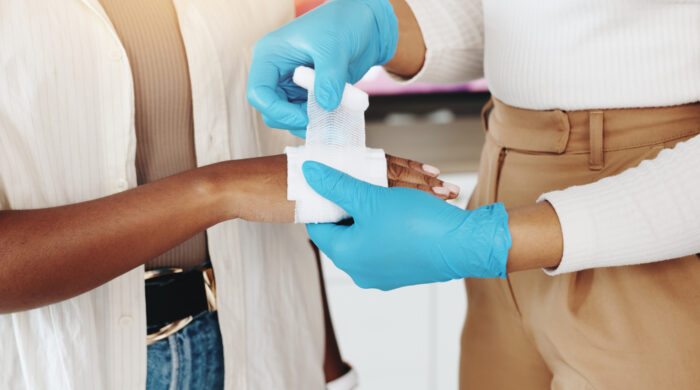
But for more superficial cuts that still require more than a band-aid, primary care providers can clean and close the wound with stitches, adhesive, or staples while managing pain with a local anesthetic.
Treating lacerations with the help of a medical provider minimizes the risk of a wound reopening. It also results in less scarring than simply putting a band-aid on the cut at home.
Casts and Splints
If you have an accident and hear a snap or see bone protruding through skin, you should go straight to the emergency room.
Alternately, if you didn’t have a break, but are experiencing swelling and pain in the injured area, make an appointment with your primary care provider for a full assessment. Many of our Family Medicine clinics offer same-day appointments for urgent needs (limited to availability, please call ahead to book your spot).
After an injury, an X-ray is usually required to tell whether the patient has a break or a sprain.
For breaks and sprains, a cast or a splint will be applied to keep the injured area immobile. This reduces pain and swelling and protects the injured area from more harm as it heals. Splints are also used for certain chronic conditions resulting from overuse, such as carpal tunnel syndrome and trigger finger.
If you suspect a sprain after an accident, or if you’re suffering from chronic joint pain, your primary care provider can assess and diagnose the problem in the clinic and, if appropriate, apply a cast or splint. For chronic joint pain, (depending on the cause) a referral to an Orthopedic specialist or Rheumatologist may also be provided.
Joint Injections
Although they don’t require an incision, joint injections are more involved than a simple shot in the arm. Injections allow a healthcare provider to apply a small amount of medication directly to the site of inflammation inside a joint, such as a shoulder, hip, knee, or the base of the big toe or thumb.
Commonly used to treat arthritis, the goal is to reduce inflammation and pain in the joint and increase the patient’s mobility.
The effectiveness of joint injections relies on the:
- type of medication used
- severity of the patient’s condition
- accuracy of the procedure
- patient’s overall health and commitment to recovery
Some primary care providers will administer joint injections in their clinic, while others may refer patients to a colleague or a specialist such as a Podiatrist or Orthopedic surgeon for the procedure.
Migraine Treatment
Another specialized injection is targeted migraine treatment with Botox®. While Botox is often known as an aesthetic treatment for facial lines, its ability to reduce muscle contractions around pain fibers can help decrease the effect of migraine triggers. It can also act as a type of anesthetic buffer that blocks the activation of pain signals in the brain.
For patients with chronic migraines who have not had success with oral preventative medications, Botox can be administered as a targeted treatment at some primary care clinics. At WWMG, this service is available at Lake Serene Clinic and Whitehorse Family Medicine.
Birth Control Recommendations
Primary care providers can prescribe several forms of birth control, including medication or surgical options. Birth control pills are considered a short-acting method of contraception, but there are long-acting treatments as well.
One long-acting option for patients is an IUD, or intrauterine device. There are several types of IUDs: one made with copper will create an environment that is toxic to sperm, while a hormonal IUD will slowly release a hormone that thickens cervical mucus.
Another birth control option, Nexplanon, is a hormone-releasing implant that is placed underneath the skin of the upper arm and can prevent pregnancy for up to 3 years.
Both IUDs and Nexplanon are reliable, long-term forms of birth control.
Vasectomy, a simple surgical procedure that cuts and seals the vas deferens, the tubes that carry sperm to the semen, is a permanent form of birth control for men.
Circumcision Services
Circumcision is the removal of the skin covering the tip of the penis, called the foreskin. Medically necessary circumcision is relatively rare compared with circumcision motivated by religious or cultural tradition.
There is some evidence that circumcision can reduce the risk of urinary tract infections and some sexually transmitted diseases. This leads some parents of newborns and a (very) few adults to opt for circumcision, which can be performed by a primary care provider right in the clinic.
Where to access these services
The services described in this article are offered by WWMG primary care providers at our Family Medicine clinics. The specific services offered at each clinic may vary by location and provider.
If you or a family member requires any of these treatments or minor surgical services, contact your WWMG primary care clinic to inquire and schedule your appointment. We’re here to help.